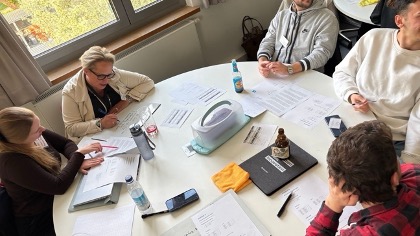
“My brain is not braining anymore!” – this phrase accompanied our attempts to uncover the secrets of the fictional language Naro. The challenge of learning a completely new language as adults vividly demonstrated the difference between child language acquisition and the conscious cognitive engagement with grammatical structures. In this session, we did not only talk about Second Language Acquisition (SLA), but experienced failure and learning firsthand through a practical experiment.
Session Overview
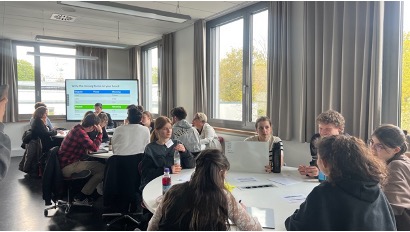
This week, Prof. Dr. Svea Schauffler, Professor for English, Cross-Cultural Management, and the Academic head of the Language Center ZSI at the THA introduced us to the world of Second Language Acquisition (SLA). Instead of dry theory, the focus was on an experiment: “Let’s learn Naro.” We became linguists in a self-experiment, identifying patterns, forming hypotheses, and discovering rules in a completely new language.
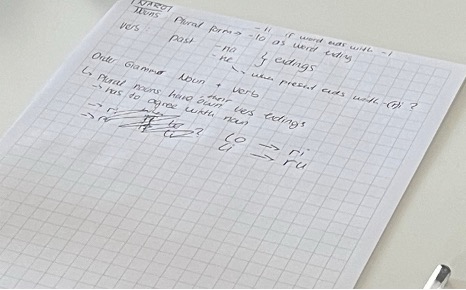
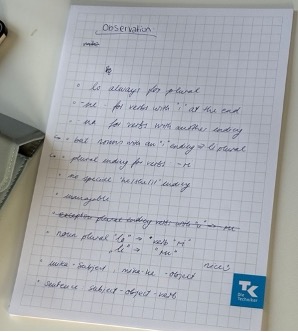
To make grammar more tangible, we developed our own methods and mnemonic devices. While in English one might learn “he, she, it – the ‘s’ must fit,” we created our own structures for Naro in order to understand the logic behind the language. For example, we noticed that we use lo when ri appears, and li when ru is involved. Remarkably, the different working groups at the tables often arrived at the same conclusions when developing these rules.
We then connected these practical observations with linguistic theories such as:
- Interlanguage Theory: The dynamic language system learners develop between their first language and the target language – in other words, the language system in our minds.
- Output Hypothesis: Only through active speaking do we notice where our knowledge gaps lie.
- Noticing Hypothesis: We learn language patterns only once we consciously perceive them.
- Interaction Hypothesis: We learn languages best through communication with others and by adapting language mutually.
Key Insights
Distinguishing Errors and Mistakes
An important learning objective was differentiating between these two concepts. Errors are systematic mistakes that indicate the underlying rule system has not yet been fully understood. Mistakes, on the other hand, are random slips of the tongue or small lapses in speech, where the learner actually knows the rule.
Learning Through Hypotheses
Language learning is an active process of testing hypotheses. Every correction we received allowed us to refine our internal language model. Correct answers felt rewarding, but it was mistakes that forced us to revise our assumptions and truly learn.
The Importance of Interaction
Language learning is a social process. Through speaking tasks with partners, we had to actively shape our thoughts into language. It was only in this interaction that we identified knowledge gaps which would have remained hidden through reading or writing alone. Learning through interaction can even happen by observing interactions – so from now on, just watch series in the language you want to learn.
Real-World Connections
The insights from this session can be directly applied to today’s world. We live in a time in which AI systems generate almost perfect texts within seconds, increasing the pressure to be flawless ourselves. Yet language learning remains deeply human and thrives on interaction. Perfectionism often holds us back.
When using a new language in professional or everyday contexts, the goal is not flawless reproduction, but rather the ability to steadily reduce the gap between what we want to say and what we are currently able to express.
Reflection
This seminar fundamentally changed our perspective. We discussed extensively that a classroom should be a safe space where people dare to make mistakes without being interrupted over every small detail.
Personally, I take away the lesson that I should more often set aside my fear of being judged by others. We often believe we will be judged when we do not speak a language perfectly, but in reality, others notice our mistakes far less than we do ourselves. In many cases, they admire us simply for speaking another language at all.
Mistakes are not a sign of failure, but the engine that drives us to discover a new world.

And Now It’s Your Turn!
Leave a comment and tell us:
Which language did you learn as a teenager or adult, and which language would you like to learn next? Was language learning a space for mistakes in your childhood?
Tell us about your last language learning experience!
Authors: Lea Braner, Lena Maywald, Sarah Assobar
Date: 21.04.2026


Leave a Reply